Author: Site Editor Publish Time: 2026-04-03 Origin: Site


We are standing at the precipice of a massive paradigm shift in electrical engineering. For over a century, power distribution has been a relatively "dumb" system—a one-way street where electricity flowed from the grid to the consumer, regulated by mechanical switches that only reacted when something went disastrously wrong. However, as we navigate through 2026, the landscape has fundamentally changed. The rise of renewable energy, the explosion of electric vehicle (EV) charging infrastructure, and the relentless demand for hyperscale data centers require a grid that is not just reactive, but proactive, intelligent, and highly communicative.
At the very heart of this technological revolution is the transition from traditional mechanical protection devices to Smart IoT (Internet of Things) Circuit Breakers. These are no longer just safety switches; they are highly sophisticated microcomputers placed at the edge of the power grid. They gather real-time data, communicate with building management systems, and utilize machine learning algorithms to predict failures before a single spark is ever produced.
According to research highlighted by the Institute of Electrical and Electronics Engineers (IEEE), the integration of IoT within electrical infrastructure is no longer a luxury for facility managers—it is an operational imperative to ensure energy efficiency, prevent catastrophic downtime, and meet aggressive global sustainability goals. In this comprehensive guide, we will explore the mechanics of smart IoT circuit breakers, why modern facilities are rushing to upgrade, and how they form the central nervous system of the future power distribution network.
To appreciate the future, we must understand how it differs from the past. A traditional Miniature Circuit Breaker (MCB) or Molded Case Circuit Breaker (MCCB) relies strictly on thermal-magnetic physics. A bimetallic strip bends when heated by an overload, or a magnetic coil reacts to a massive short-circuit current, mechanically pulling the contacts apart. Once it trips, someone must physically walk to the panel, diagnose the issue (often blindly), and manually reset the switch.
A Smart IoT Circuit Breaker retains these fundamental physical safety mechanisms—because physics never fails—but overlays them with advanced microprocessors, solid-state sensors, and wireless communication modules (such as Wi-Fi, Zigbee, LoRaWAN, or 5G).
These devices constantly monitor multiple parameters thousands of times per second: voltage, current, active power, reactive power, power factor, frequency, and internal temperature. This data is processed locally (Edge Computing) and transmitted to a centralized cloud dashboard or a local SCADA (Supervisory Control and Data Acquisition) system. This transforms a passive safety device into an active energy management tool.
Why is there a sudden, massive capital expenditure shift towards smart electrical infrastructure? The answer lies in the converging pressures of modern industrial and commercial operations.
The Demand for Predictive Maintenance: In manufacturing and data centers, unplanned downtime costs thousands of dollars per minute. Traditional breakers only tell you after a failure has occurred. IoT breakers analyze micro-fluctuations in current signatures to detect degrading motor insulation or loose connections weeks before a fault happens. You fix the problem on your schedule, not the machine's.
Aggressive Energy Management and ESG Goals: With volatile energy prices and strict carbon reporting mandates (ESG criteria), companies must know exactly where every kilowatt-hour is going. Smart breakers act as sub-meters on every individual circuit, identifying "vampire loads" and highly inefficient machinery that needs replacing.
Distributed Energy Resources (DERs): Modern buildings generate their own power via solar panels and store it in massive battery banks. Power no longer flows in one direction. Smart breakers manage this bi-directional power flow, isolating sections of the building during grid outages to run off solar and batteries without disrupting critical loads.
A smart IoT circuit breaker does not operate in a vacuum; its true power is unlocked when it functions as the sensory input for broader automation systems. In highly automated environments like automotive assembly lines or chemical processing plants, the electrical distribution board must seamlessly "talk" to the machinery it powers.
When a smart breaker detects a slight, anomalous rise in current on a conveyor belt motor (indicating a potential mechanical jam), it doesn't just trip the power abruptly, potentially ruining a batch of products. Instead, it sends an early warning signal via Modbus or PROFINET to the factory's PLC (Programmable Logic Controller). The PLC can then gracefully spin down the motor and alert the maintenance crew.
To build such a responsive and interconnected factory floor, engineers must pair IoT breakers with robust and highly communicative advanced industrial control devices, such as smart contactors and motor protection relays. This synergy creates a closed-loop system where power distribution and mechanical control operate as a single, intelligent entity.
While monitoring and data are the exciting new features of IoT, the fundamental purpose of any electrical board is uncompromising safety. A modern smart grid must protect against invisible threats like earth leakage and voltage anomalies, which can cause electrical fires or destroy millions of dollars of sensitive IT equipment.
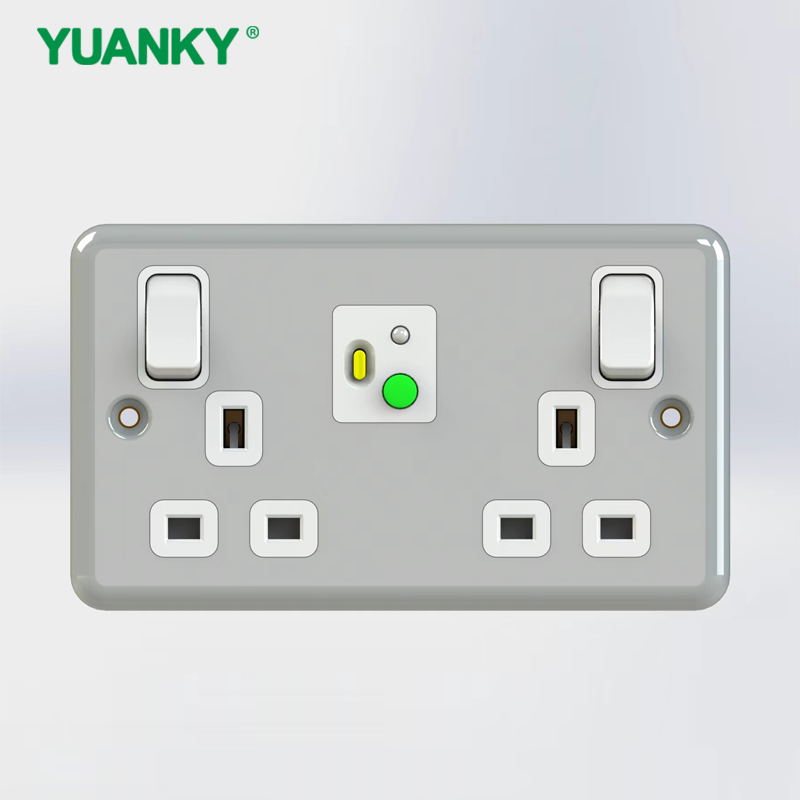
Smart circuit breakers are increasingly being integrated alongside, or built directly into, advanced residual current technologies. In commercial buildings and industrial sites where moisture or harsh conditions exist, integrating high-performance RCD protectors is critical. These devices monitor the balance between live and neutral wires, instantly cutting power if current leaks to the ground (potentially through a human body).
For remote work sites, construction zones, or maintenance teams performing diagnostics on these new smart grids, having reliable portable residual current devices (PRCD) ensures that workers are protected from electrocution even when plugging into temporary or unverified power sources.
Furthermore, as the grid integrates more intermittent renewables like wind and solar, voltage sags and swells become more common. A smart system relies on automatic voltage protectors to shield sensitive microprocessor-driven equipment (including the smart breakers themselves) from these damaging fluctuations, automatically disconnecting the load until the grid stabilizes.
You would not put a state-of-the-art supercomputer inside a leaky cardboard box. Similarly, as the components inside the electrical panel become highly sophisticated, delicate, and expensive, the physical enclosure that houses them must evolve.
Smart IoT circuit breakers require stable operating temperatures to ensure their internal microprocessors function correctly. They also rely on wireless antennas that can be severely hampered by electromagnetic interference (EMI) or improperly designed metal shielding. Therefore, upgrading to smart technology mandates utilizing premium, properly rated electrical distribution boxes.
These modern enclosures offer superior IP (Ingress Protection) ratings against dust and water, specialized thermal management systems (like passive cooling vents or active climate control), and advanced structural integrity to withstand industrial vibrations. A smart grid is only as reliable as the physical box protecting its most critical nodes.
The upfront capital expenditure for smart IoT circuit breakers and related infrastructure is undeniably higher than buying traditional mechanical switches. However, in 2026, Chief Financial Officers and Facility Managers look at the Total Cost of Ownership (TCO) over a 10 to 15-year lifecycle. The Return on Investment (ROI) is realized rapidly through three main channels:
First, Reduced Troubleshooting Time. When a traditional breaker trips in a sprawling hospital or factory, an electrician must physically hunt down the panel, trace the wire, and guess what caused the overload. With IoT breakers, the facility manager receives an instant push notification on their smartphone pinpointing the exact breaker, the specific circuit, and the exact fault data (e.g., "Phase B Short Circuit at 4,500 Amps"). Maintenance time drops from hours to minutes.
Second, Energy Optimization. By acting as highly granular smart meters, these devices reveal precisely where energy is wasted. Facilities often discover that HVAC systems are running unnecessarily overnight, or specific manufacturing lines are drawing excessive phantom power. Correcting these inefficiencies often results in a 10% to 20% reduction in monthly utility bills.
Third, Remote Actuation. Smart breakers feature motorized mechanisms allowing them to be turned on or off remotely via a secure software dashboard. This allows for automated load shedding during peak utility pricing hours, significantly reducing peak demand charges.
The transition to a smart, predictive, and highly efficient electrical grid is not just the future—it is the reality of 2026. At YUANKY, we are at the forefront of this revolution, engineering components that bridge the gap between heavy-duty power distribution and cutting-edge IoT data analytics.
To build a resilient and intelligent power network, you must start with the core. We invite you to explore our flagship range of industrial circuit breakers. Engineered for absolute precision, these breakers offer the rapid fault-clearing capabilities required to protect your most expensive assets, serving as the ultimate foundation for any modern smart panel upgrade.
Because intelligent components require superior environmental protection, housing your upgrades in our rigorously tested custom industrial distribution panels ensures that your microprocessors, communication modules, and relays are shielded from dust, moisture, and industrial wear-and-tear for decades.
Furthermore, to achieve true factory automation and predictive maintenance, seamlessly integrate your power distribution with our advanced industrial control devices. Together, YUANKY products create an uncompromising ecosystem of safety, efficiency, and intelligence.
Do not let your facility fall behind. Partner with a manufacturer that delivers the future of electrical engineering today.
Consult with YUANKY Experts Today
Can smart IoT circuit breakers be retrofitted into existing distribution panels?
Yes, in many cases they can. Leading manufacturers design smart circuit breakers to match the standard DIN rail dimensions of traditional MCBs and MCCBs. However, you must ensure the panel has adequate space for any additional communication gateways or wiring required for the IoT connectivity.
Are IoT circuit breakers vulnerable to cyberattacks or hacking?
Cybersecurity is a massive priority for smart grid technology. High-quality IoT breakers utilize advanced encryption protocols (like AES-256), secure cloud architectures, and strict authentication to prevent unauthorized access. It is crucial to change default passwords, keep firmware updated, and isolate the electrical network from public Wi-Fi on a secure corporate VLAN.
What happens to a smart circuit breaker if the Wi-Fi or internet goes down?
Smart IoT circuit breakers are designed with a "fail-safe" architecture. The primary function of a circuit breaker is physical safety. If the internet connection or local network goes down, the internal thermal-magnetic mechanisms continue to operate perfectly. It will still trip instantly during a short circuit or overload; it simply won't be able to send the notification to your app until the connection is restored.
Do smart circuit breakers measure energy usage accurately enough for billing?
Many high-end smart breakers feature "revenue-grade" metering accuracy (often Class 1 or Class 0.5 according to IEC standards). This makes them incredibly accurate for internal sub-metering, cost-allocation between different departments in a factory, or billing individual tenants in a commercial building.
Why do I need a Voltage Protector if I have a Smart Circuit Breaker?
A circuit breaker protects against overcurrent (too many amps) and short circuits. A voltage protector monitors the electrical potential (too many or too few volts from the grid, like surges or brownouts). While some advanced smart breakers have voltage monitoring built-in, dedicated automatic voltage protectors offer specialized, rapid disconnection to save sensitive electronics from grid instability.